
The electricity system is under pressure
Something structural is shifting in European electricity markets, and it is happening faster than most expected.
Two forces are driving this. On the supply side, solar and wind now account for a growing share of the generation mix — and unlike nuclear or gas, they cannot be dispatched on demand. The predictable baseload floor that nuclear once provided is quietly eroding, squeezed by ageing plants and a political climate that has, in many countries, made large-scale nuclear expansion a slow or contested process.
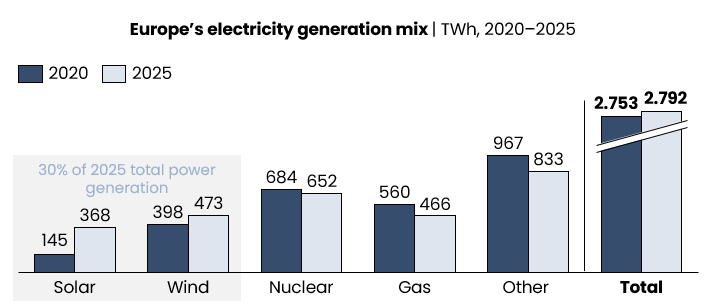
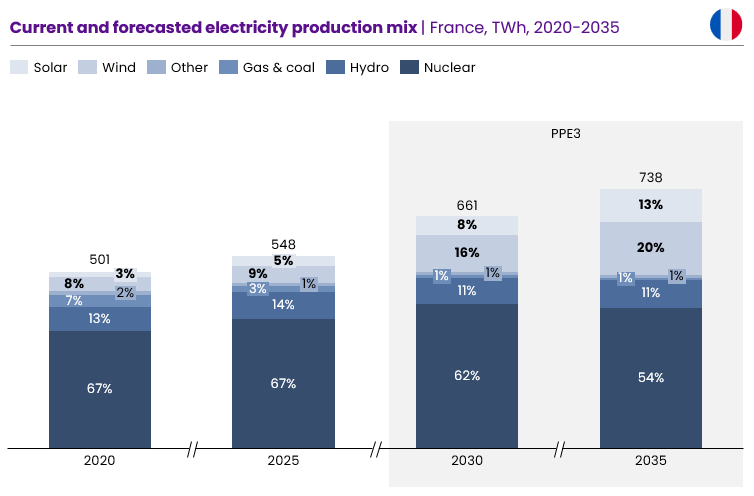
On the demand side, electrification is picking up pace. Electric vehicles, heat pumps, and industrial process upgrades are all introducing sharper, less predictable load profiles. And as C&I consumers move away from fixed-price contracts towards spot-indexed or “block + spot” supply arrangements — often guided by energy brokers — their exposure to price volatility is rising accordingly.
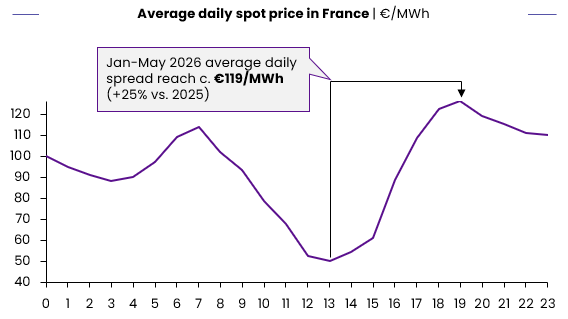
The combined effect is a wholesale price structure that looks nothing like it did a decade ago. Midday prices regularly collapse under the weight of solar generation, while evening peaks — still set by gas-fired plants covering residual demand — remain elevated. The “duck curve,” once a Californian curiosity, is now a feature of several European markets. In Europe, the number of hours with negative spot prices has increased seventeen-fold over five years. Recent geopolitical events, including the conflict in Iran, have pushed peak prices higher still, widening spreads further.
For a battery, that spread is the opportunity.
1. “Behind-the-Meter” BESS: Value on Both Sides of the Meter
The first generation of large-scale battery projects — utility-scale, front-of-the-meter — ran into a problem that has become all too familiar: grid connection queues stretching years into the future. In many European countries, a project awarded today may not be connected until the late 2020s. That delay erodes returns significantly.
The behind-the-meter (BTM) model sidesteps this entirely. By installing the battery directly on a customer’s site and routing it through the site’s existing grid connection, there is no new connection to apply for. The infrastructure is already there. Development timelines shrink, and the economics improve accordingly.
What makes the BTM model distinctive, though, is not just the avoided connection cost. It is the revenue structure. A BTM battery is a dual-revenue asset:
- It reduces the customer’s electricity bill directly — through PV self-consumption optimization, off-peak/peak tariff arbitrage, and peak-shaving to bring down contracted power capacity.
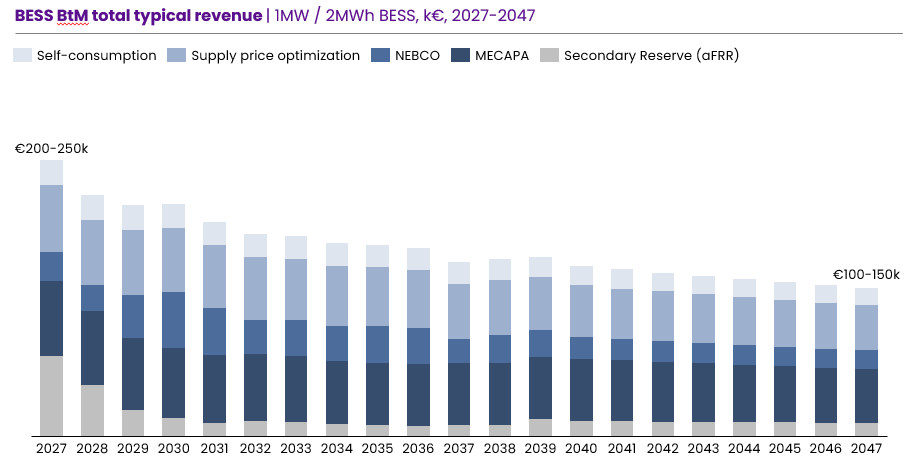
- It also participates in wholesale and ancillary services markets — secondary reserve, capacity mechanisms, SRAD in Spain, intraday arbitrage via NEBCO in France — generating revenues that are entirely independent of what the customer pays for their electricity.
Stacking these two income streams is what sets the BTM business case apart from its FTM counterpart. Neither stream alone is remarkable; together, they make the model genuinely resilient. stacking,” which is one of the distinctive characteristics of the BTM model.
2. BESS as Infrastructure, Not Just an Add-On
There is a tendency to treat battery storage as an optimization layer — something you bolt on at the end of a project to squeeze out a bit more value. That framing is increasingly outdated.
As C&I and industrial sites electrify their operations — adding EV charging infrastructure, heat pumps, and electrified thermal processes alongside existing PV installations — the complexity of managing on-site energy grows rapidly. Multiple assets, each with its own demand curve and operating logic, need to be coordinated. Without storage, the result is power peaks that breach contracted capacity limits, curtailed solar output, and a consumption profile that is expensive and hard to manage.
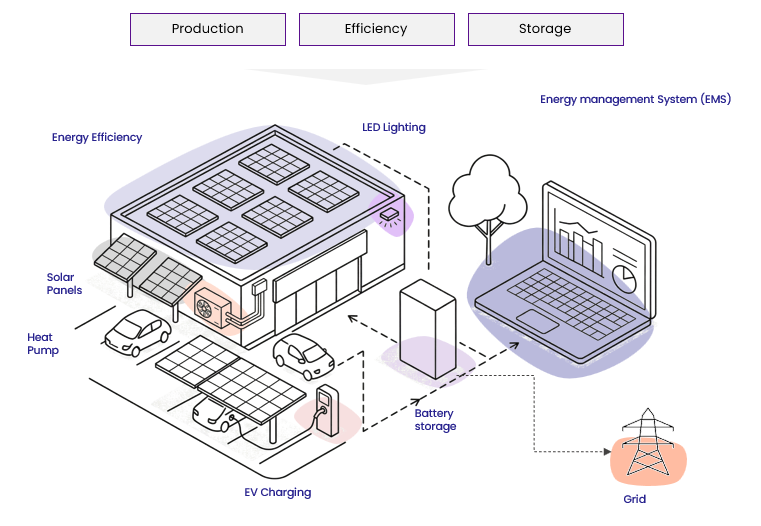
A BTM battery, paired with an Energy Management System (EMS) and intelligent dispatch algorithms, provides the coordination layer that makes the rest of the system work. It absorbs PV surpluses, smooths the spikes from charging stations and heat pumps, and keeps the overall site profile within its power subscription. Without it, these multi-asset electrification projects either underperform or require a costly increase in contracted grid capacity.
This is why the battery is increasingly specified at the design stage of electrification programs, not retrofitted afterwards. For industrial players and commercial property managers running serious decarbonization programs, the battery is what makes the overall project technically and economically coherent.
3. The Window Is Open — and the Long-Term Case Is Solid
The BTM storage market in Europe is still young. That immaturity is, right now, a feature rather than a bug.
Demand for flexibility is high — the electricity system needs it, and the structural drivers are only intensifying. But the pool of BTM flexibility assets is still small. The result is unusually strong pricing. In France, the average intraday spread stood at around €90/MWh in 2025, compared to €22/MWh in 2019. Ancillary services revenue, particularly secondary reserve, remains well-supported.
This will not last indefinitely. As more BTM assets come online, spreads will compress and ancillary service payments will normalize. That compression is already being modeled into long-term business cases. But a partial normalization of near-term revenue levels does not break the underlying investment thesis — it simply recalibrates it.
The long-term case rests on fundamentals that do not depend on the current pricing cycle:
- Dispatchable capacity is being retired faster than it is being replaced, keeping structural price spreads elevated
- The more intermittent the generation mix becomes, the more the system needs fast, flexible response — and that demand will not diminish
- Regulatory reform is moving, slowly but directionally, towards better recognition and remuneration of BTM flexibility (TURPE 7 in France, evolving capacity mechanisms in Spain and elsewhere)
- As electrification of end uses deepens, on-site consumption profiles become more volatile, making storage more valuable, not less
The short-term opportunity is real. So is the long-term one.
4. A Three-Player Ecosystem — and Why It Matters
Deploying a BTM BESS asset on a C&I or industrial site is not a single-player activity. It works best when three types of players each bring what they do well.
The end customer — the site owner or operator — provides the physical anchor: the load profile, the operational constraints, and ultimately the willingness to host the asset. Their consumption behavior shapes the entire dispatch strategy.
Aggregators are the market access layer. Through real-time control platforms, they continuously manage the battery’s allocation across different revenue streams — arbitrating between spot signals, reserve commitments, and the immediate needs of the site. Without them, the market revenues simply are not reachable for a single BTM asset.
ESCOs and third-party investors bring the customer relationships and the financing. Many of them have spent years building portfolios through PV self-consumption and energy efficiency contracts. Those same customers are now candidates for a BTM battery offer. Their site knowledge, ability to structure off-balance-sheet financing, and long-term operational presence make them well-positioned to deploy these assets at scale.

What creates value here is not any one of these players acting alone. It is the way they fit together — each covering a capability the others lack. Projects that get this coordination right are the ones that make the economics work over a 20-year asset life.
5. Summary
The behind-the-meter battery has quietly moved from niche product to essential infrastructure. It addresses a genuine and growing need of the electricity system, delivers measurable cost savings to C&I sites, and generates market revenues that are structurally supported for the long term.
The current environment — wide spreads, strong ancillary services revenue, limited BTM competition — makes this an unusually favorable moment for early movers. That window will not stay this wide forever. But even as the market matures and revenue levels normalize, the structural case for BTM storage remains intact, built on fundamentals that electrification and grid transformation will only reinforce.
How PMP Strategy can help
PMP Strategy can model the full revenue stack available to a behind-the-meter battery — across intraday markets, ancillary services, and on-site savings — providing investors, ESCOs, and industrial players with a rigorous basis for their business case.
Article by PMP Strategy: Laura Papet-Arnal, Associate Partner, Philippe Angoustures, Partner, Ronan Pilard, Manager

About PMP Strategy
PMP Strategy is an independent International strategic management consulting firm distinguished by Partners who bring C-level operational experience and combine deep sector expertise with strategic rigor to deliver tangible, lasting impact.
For over twenty years, we have served as trusted advisors to executive committees and investors across North America, Europe, the Middle East, and Africa. We specialize in five key sectors where transformation is most critical: Telecoms, Media & Technology (TMT), Private Equity, Financial Institutions, Transport & Mobility, and Industry & Energy. Our Transversal Performance practice leads complex, cross-sector transformation programs, while our Innovation Lab—a dedicated team of AI experts—supports client engagements worldwide from our headquarters in Paris and our network of international offices.
Our approach is built on partnership—designing tailored strategies alongside clients and working hand in hand to drive implementation, delivering measurable results that evolve with their ambitions.
Learn more at www.pmpstrategy.com
Press contact:
Jennifer Campbell
+33 6 32 05 14 27
jcampbell@pmpstrategy.com